Sunday, August 28, 2016

Focus Screen Part 2

In my last blog post I talked about the Focus Screen on your camera and what it does. This week I am writing part two of this article on how to replace or clean your Focus Screen properly so that you can always have a clear viewfinder to look through.

To remove your Focus Screen for cleaning or replacement, you need a Focus Screen tool. This is a special, plastic, tweezer-like tool that can grab the Focus Screen by it’s little tab and remove it safely. If you take off your lens and lay the camera on it’s back, look at the top of the lens opening and you will see a small metal tab. Flip that down carefully with your finger or tweezers and that releases the frame, and there the Focus Screen is.
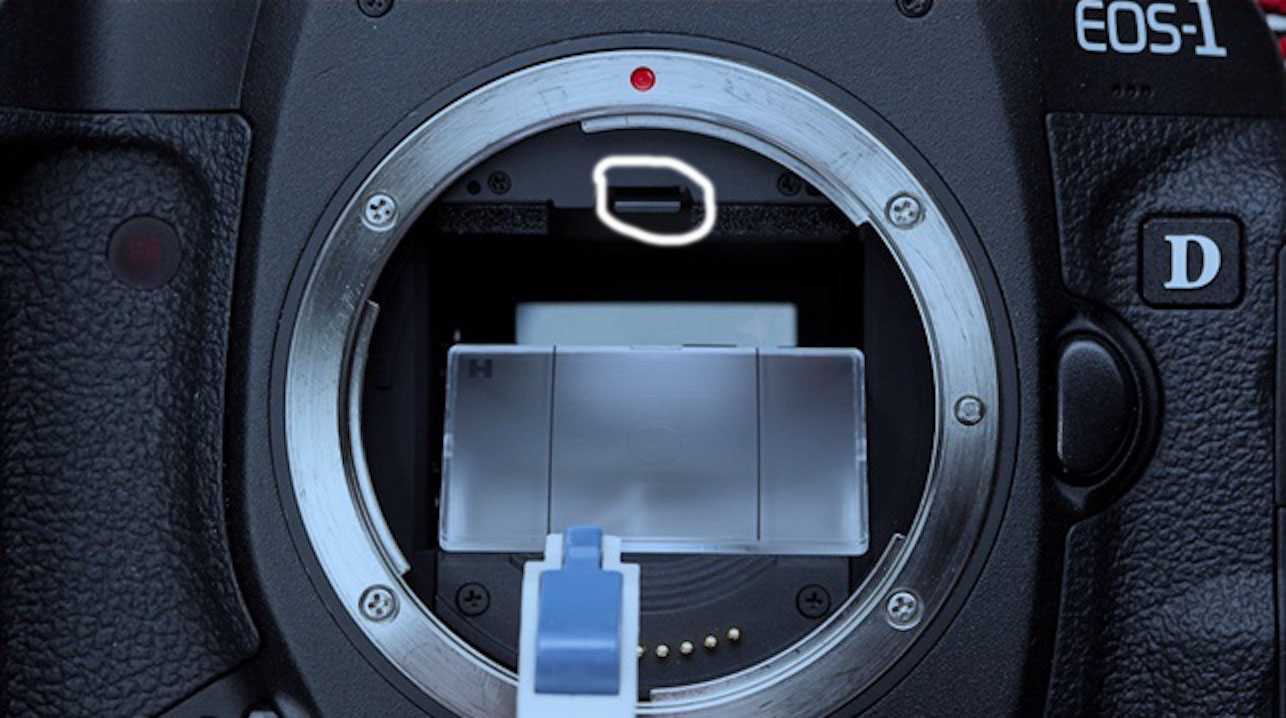

Focus Screen release tab is circled in white.

Once you have flipped the Focus Screen frame switch, the frame drops down on it’s own and you can see the Focus Screen. Using the Focus Screen tool, grab the Focus Screen by the tab and gently lift it out of the camera.
New Focus Screen and grabber tool in the plastic box
 To clean the Focus Screen, Canon recommends you use a Rocket Blower first to see if you can blow any of the particles off the Focus Screen. You can then re-insert it with the tool, close the frame and look through your viewfinder to see if you were successful. If not, remove the Focus Screen again and you can try cleaning it with soap and water.

Prepare some warm water in a small dish or cup, you can use Distilled water but it’s not required. Add a small amount of dish soap like Dawn or whatever you have in your kitchen. Put the Focus Screen in the solution and let it soak for a bit, remove it from the solution and gently brush it with a horsehair brush, like a small paint brush, new of course, that people use to paint models.

Next, use your Rocket Blower and blow the Focus Screen dry, never use your breath. You can use compressed air, but make sure you don’t freeze the Focus Screen by blowing it too closely with the compressed air. Once you feel it’s clean, and dry, put it back into the frame and snap the frame back into place. Never touch the Focus Screen with your fingers, other than by the side edges as the oils in your skin will make a mess of the Focus Screen and that oil is pretty much impossible to get off again according to Canon.

Rocket Blower for cleaning sensor and Focus Screen

Check your viewfinder again, if it’s clear, you are good to go! I sometimes try to clean my Focus Screens, but I have bought used cameras and had the Focus Screen just so incredibly dirty that I just replaced it. You can buy new Focus Screens from Canon, Nikon (if you are a Nikon shooter), B&H, Adorama, or Amazon. When you order a new one they come in a nice plastic tray assembly with a snap close lid and the tool comes with it. After I remove my old one and swap it out, I put the old one in the tray and store it in a drawer just in case I need an emergency spare.

Now, if you don’t have the stomach to clean the Focus Screen, you can easily just replace it yourself or take your camera to a camera shop to do it for you. I will warn you that depending on where you live, it can cost you upwards of $200 to have it changed. If you are a CPS member, Canon will clean it for free along with your sensor once a year, but you have to ship it to them and be without your camera for a few days.


Comments/Questions

Sunday, August 21, 2016

Focus Screen Part 1

This week’s blog post I wanted to write about a specific part of the camera system that you may or may not be familiar with, the Focus Screen.

The Focus Screen is a small piece of flat, translucent material, either ground glass or a fresnel lens. It is located inside the front of your camera where the lens mounts and help you acquire focus and frame your shot through your camera’s viewfinder.

Canon Eg-A Focus Screen
 There are various types of Focus Screens for most cameras and they can be either etched or non-etched. There are even Focus Screens which are made specifically for using low light lenses.

Some cameras have plain Focus Screens and others have etched ones that denote the focus points and even have a grid for maintaining your “Rule of Thirds”. Many of the newest mid-range and professional DSLRs have a plain Focus Screen with a monochromatic LCD overlay that reveals the focus points when you depress the shutter button halfway.

One of the interesting things about your Focus Screen, aside from the fact that many people do not realize their camera has one, or that it’s easily replaced, is the fact that if the Focus Screen picks up dirt, many photographers think it’s their sensor that’s dirty when that is not the case. If you are someone like myself that has an OCD thing about even the smallest spec of dust in my field of vision, the Focus Screen can be a source of annoyance.


Image of a dirty Focus Screen, courtesy of Ken Rockwell

Have you ever looked through your viewfinder and noticed little black specs or even tiny black strings? Well, chances are if you have seen this, it is your Focus Screen that is the culprit and not your sensor. Especially if you see the dirt, but it does not show up in your photos.

Cross Section of a DSLR, Number 5 is the Focus Screen
Focus Screens can be a pain to clean and there are specific methods to do so, which I will go into in my next post. For now, either try to ignore the dirt in your field of view if you can, or go on-line and order another Focus Screen and replace your old one. You can generally buy new ones for around $20-$35 a piece, but look up which model your camera came with originally and buy the same one. Most all Canon cameras come with what’s called the Precision Matte “Eg-A” Focus Screen and the new one will come with a special tool to remove the old one and put in the new one. Whatever you do, do not touch the Focus Screen with your fingers. My next post will be on how to remove and replace your Focus Screen as well as how to clean it PROPERLY.


Comments/Questions

Sunday, August 14, 2016

Great Plugins


One of the items that can come in handy for your Post-Production is plugins or add-on software for your Photoshop and Lightroom. These can be handy little programs that can give your images a little extra “pop” to make them really stand out.

The ones I want to talk about today are the Creative Kit 2016 pack by Macphun software. Macphun makes software for Macs only and their plugins are very good and can really take your images to the next level.

Creative Kit 2016 comes with six programs, which are Intensify, Tonality, Snapheal, FX Photo, Focus and Noiseless.

Intensify will help with powerful Structure, Sharpness and Details using Pro contrast and comes with dozens of built in image presets.


Tonality is a Black & White photo editor, which allows you to reimagine your monochrome image editing with hundreds of presets, layers,unique digital controls, authentic grain effects and more.


Snapheal allows you to remove unwanted objects and strangers from your photos. You can cut any odd or excessive details. It also features a Clone & Stamp tool to help you replace them with something nice. I like this one as I think it does a better job at removing objects than Photoshop alone.


FX Photo Studio allows you to experiment with styles and looks for your images. Use the large selection of filters to create customized, unique images, you can combine or apply them selectively for some really “special” images.


Focus allows you to add Pro lens effects without the expensive gear. Use smart blur controls and powerful lens effects, including adding your own bokeh in Post Production.


Noiseless will get rid of digital noise and preserve details in your structure and save your night shots by turning them into crispy & clear images. Have Noiseless work on your images pixel by pixel to make them smooth and vibrant instead of deleting them because of noise.


You can buy the entire Creative Kit 2016 on sale for $129.99, marked down from $339 and you can buy it in installments of $25 over 5 monthly payments. If you search the web you might be able to find it even cheaper, I got a deal through Stack Social and I paid only $53 for the entire kit and the nice thing is you can install it on as many Macs as you want with one license.

One final note, some people Love the new “Photos” app in OS X that replaced Aperture, some people hate it and want Aperture back. I prefer Aperture myself and bought it years ago so I will always have it. But if you do like using the “Photos” app for even minor post production, Macphun has updated Creative Kit 2016 so their plugins will even work in “Photos” as “Extensions” or plugins in the Apple world.

All of these plugins will install into Aperture, Photos, Lightroom, Photoshop and Photoshop Elements so you can use them on whichever of these programs is your favorite.


Comments/Questions

Sunday, July 31, 2016

Another Way to Improve Post Processing Performance

This week I want to write another article on ways to improve your post processing workflow from a performance standpoint. You'll remember I wrote a blog post about tweaks for Lightroom, well today's post will not only speed up Lightroom, but also Photoshop and anything else you are using for Post Production. How can I be certain this will enhance EVERYTHING you say, well because for my day job, I am an I.T. Professional of 25 years.

Some of you may or may not have heard of SSD's also know as Solid State Disks or Solid State Hard Drives, but you may not be sure what they are or how they can benefit you as a photographer. Well an SSD, unlike a conventional hard drive has no moving parts, there are no metal platters inside and no head that reads them similar to an old record player.

Crucial 500GB SSD MX 200 series

 A Solid State Drive is basically a giant memory card, so it can read and write data insanely fast compared to a conventional hard drive which can only read and write at the speed that it's platters spin at. When SSD's first came out 5-10 years ago they were extremely expensive as most anything in electronics or computers, but over time, they become more and more cost effective in comparison to their platter counter-parts.

How will an SSD speed up your Post Processing and workflow? Well, the latest SSD's are capable of reading and writing data at 6GB/s, that's 6 Gigabits per second compared to platter drive which can only write at upwards of 15,000 Bits per second and that's only if you buy the expensive SAS drives, which are usually used more in servers than home computers.

I went this weekend and bought a used Mac Mini Server as a second computer and bought a 2012 model as it is the last year Apple made them user upgradeable, allow you to add more RAM and to easily swap out the hard drive from the old style platter model that only ran at 5,200 RPMs. I then went to Microcenter and bought a nice Crucial MX200 series 500GB SSD in 2.5 inch form factor. The Crucial is the best in SSDs and they have been one of the leading makers of system memory for decades, so it only stands to reason that they would also make the best SSD's since, again, an SSD is nothing more than a massive memory card that plugs into the hard drive ports on your computer and doesn't erase when the system is rebooted or powered off like RAM does. The model I bought it 500GB @ only $149 and will allow either a Windows or Mac based system to boot from cold start to the desktop in 7-15 seconds!

Crucial 500GB SSD plugged into a Windows PC

An SSD will also allow your applications to load hundreds of times faster such as Lightroom, Photoshop, or even Apple Final Cut Pro X video editing software which I use for my DJI Phantom 3 Professional videos. Ever seen that dreaded hourglass or spinning beach ball in Window or Mac? Well kiss them goodbye with an SSD as those kinds of things never happen again. Even though your Windows machine will still need to be defragmented now and then, image your Defrag only taking minutes instead of hours.

Now I am sure a lot of you are thinking, "How can I get this in my current system?" Well if you are handy with a screwdriver, most people can replace a hard drive themselves and then just restore your Operating System and applications from backups or do a clean install. A Windows 10 install that can take an hour or more on a conventional hard drive can be installed on an SSD in 15-20 minutes! If you don't have the stomach for this work yourself, find a local computer shop that will swap out the drives for you for a reasonable fee. If you do decide to tackle it yourself, Google how to do it as many videos exist on YouTube that will show you step by step how to do it yourself.

Trust me, once you've gone to SSD, you'll never go back to an old style hard drive again and you'll certainly appreciate the boot in speed when doing your Post Production.

Comments/Questions

Sunday, July 3, 2016

Drones and Your Photography Business

So this past week PPA (Professional Photographers of America) sent out an email that the FAA has released it's new rules on drones for business. According to the new FAA rules, the estimated out-of-pocket cost for an individual to become certified as a remote pilot with a small UAS rating is $150. This will cover the testing fee.


My Phantom 3 Professional hovering in my front yard.

The required aeronautical knowledge test will cover the following subject areas:

- Regulations applicable to small UAS operations

Airspace classification and operating requirements, maintenance and inspection procedures, and flight restrictions affecting small unmanned aircraft operation
Official sources of weather and effects of weather on small unmanned aircraft performance
Small UAS loading and performance
Emergency procedures
Crew resource management
Radio communication procedures
Determining the performance of small unmanned aircraft
Physiological effects of drugs and alcohol
Aeronautical decision-making and judgment
Airport operations.

You'll be able to take the test at more than 700 FAA-approved testing centers. Get more information from the FAA on certification here!

A shot of my cul-de-sac from my Phantom 3 Professional
 There are also some new changes in the rules that will becoming out in August 2016, so you may want to wait a few more weeks to actually start the licensing process. Remember, you are ultimately responsible to make sure you are legal to fly your drone for your business and getting caught without a proper pilot's license will result in hefty fines and possible jail time!

Comments/Questions

Sunday, June 19, 2016

Are Drones Dangerous?

As I am sure you and most everyone is aware by now, drones are becoming more and more mainstream, especially professional drones. No I am not talking about the Reapers that Uncle Sam uses to rain down Hellfire missiles on terrorists, I am talking about photography and videography drones.

I personally own the DJI Phantom 3 Professional drone and love it! But many people are nervous or even scared of drones after all of the negative coverage on the news, especially on TV. They hear stories about drones falling on people or crashing into objects and wreaking havoc on innocent people.

People are afraid of many things, and thanks to all the negative press, many people are afraid of drones. They are paranoid that someone is using a drone to film them in the shower, or in some other "Peeping Tom" fashion, or that a drone will fall out of the sky and hit them or their children in the head.

Still from video I shot in Barnesville, Ga with my Phantom 3

The truth is drones are no more dangerous that anything else and safer than cars, yet you drive your car all over town every day and never give another thought about it. The incidents of drones crashing are the exception, not the norm as a general rule, anyone like myself that has spent considerable money on a professional grade drone will take the time to learn everything they can about it to fly it as safely as possible. I watched hundreds of videos on the Phantom 3 and drones in general to try and make myself as knowledgeable as possible on the subject of drones and safe drone flying.

Additionally, the better, professional drones like mine come equipped with a "Safe Mode", which prevents the drone from flying more than a certain distance away from it's GPS "home point" and it also doesn't allow you to fly more than so many meters off the ground. The manufacturers
put these safety features into their software to help prevent people from making serious mistakes and hurting people or property. Once you have mastered your drone and honed your piloting skills, you can take it out of "Safe Mode" and then you can fly mine up to 2 miles from the take off point and fly to the maximum legal altitude which is 400 feet in the U.S.

The point I am making is that drones, like many other items are just another tool in a professional photographer's bag. A drone can be dangerous, but why live in fear of something happening when the chances are Slim to None and Slim is out of town. I personally have practiced with mine a lot while nowhere near people or property, I also use and recommend an app call UAV Forecast, which uses your GPS location to tell you if the weather is suitable for flying or not.


Railcar I shot in Barnesville, Ga with my Phantom 3

Most anyone that is a serious drone photographer or videographer is going to spend considerable time learning everything they can about their new gear before they ever use it out near people or objects that it could cause harm to, no one want to pose a risk to the health and well-being of others on purpose and most of us also buy special drone insurance just in case something does go wrong. Many of you probably don't even realize that a lot of your favorite TV shows and movies now use professional drones with professional "pilots" flying them to film.

With the enormous cost in making a block-buster movie these days, studios look to save money any way they can and a $1,000-$5,000 drone that be used over and over again is way more cost effective than say a $60,000 a day camera boom truck. Just as many of you might not be aware, but the GoPro action camera is also used by many studios for shooting TV shows and movies because again a few $300-$400 GoPros mounted on car bumpers for chase scenes are way cheaper and the GoPro is capable of extremely high-quality video and stills with it's 12MP camera capable of 1080p or even 4k HD video as the new model is capable of and so is my drone.

If there is one thing I want you the reader to take away from this week's post is that drones are nothing more than another camera "body" and most of them are being flown by professionals who take flying and filming with them as seriously as any other photographer using any other conventional camera body and lens combination. So, next time you are out at a skate park or some vacation spot like a beach in Florida and see someone flying one of these professional drones, instead of being afraid of the drone, walk over and strike up a conversation with them.
I have people walk up to me and ask me about mine all the time and many times they ask me to shoot some footage or stills of them.

Keep in mine that the media loves to blow things out of proportion as they are looking for ratings and sensationalism and less about sharing the truth on a subject. Now get out there and check out some drone photographers, or rent one and try it out for yourself!

Comments/Questions

Sunday, June 5, 2016

Don't Let Social Media Stifle Your Creativity

Social media sites like Twitter, Instagram, Facebook, 500px.com and others can be a great way to share you work as a photographer, but they are not the end all be all. Many times photographers get discouraged with the results they find on these sites, especially if they don't receive a large amount of "Likes" or "Shares" or "Favorites".

These responses are not an accurate gauge of your creativity or ability as a photographer, they are more the results of Social Media popularity contests. I have talked to and see so many photographers become discouraged with these platforms because they don't gets tons of "Likes" or "Shares", they think their work is not good enough or that no one likes they creative flare.

When it comes to your art and your work, you have to be the one true judge of your creativity and always strive to try new things and think outside the box. I can personally tell you from experience that I have posted photos on 500px.com and even on Facebook that got very little attention, but that same photo on EyeEm.com and Getty Images is selling like hotcakes.


Tybee Island Sunrise - Not liked at all of Social Media, sold 50 copies on Getty Images
 On the other hand, images I have posted that got scored really high or gotten lots of "Likes" and "Shares" didn't sell at all even though they were fantastic images and very creative and visually pleasing. The point is you are the best one to determine your best work and you can also get a more professional, objective opinion from your professors while you are still in college or from other professionals you are friends with or network with in the real world.

Social Media sites and platforms can be great for getting your work out there and noticed by a wider audience of people and perspective clients, but if you go into Social Media with the wrong mind-set, it can also suck the life out of you creatively. I find that a good way aside from the ones I mentioned a moment ago to have your photos honestly critiqued is to join some of the larger photography groups on Facebook that have been around for a while and have a large number of pros and seasoned hobbyists that are very active on there.

I personally created a Photography Twitter account that is totally separate from my personal one and have picked up quite a few professional photographers as followers and some of them are even nice enough to talk to me on there via Direct Message on a regular basis and are even kind enough to give me honest feedback on my work that I post there all the time. Some of your more famous photographers like Chase Jarvis and Zack Arias won't give you the time of day on there and most of them won't even answer emails either but there are still some pros out there that are more than happy to talk to you and even critique your work, such as Jared Polin from FroKnowsPhoto.com, Josh Schmidt from PhotoTipsHQ.com, Ken Rockwell from www.kenrockwell.com and Leigh from www.snapchick.com.

Wall of Light - Got tons of Likes and Shares, was used by AI for publications, never sold a copy
 I have also had personal exchanges by email with David Hobby and Scott Kelby as well, but they are a bit harder to catch up with as they are always so busy and get so much email, and I have never felt like bother either one of them for a photo or portfolio review/critique.

The point I am trying to make is you cannot let these sites pull you down and make you second guess your abilities or creative abilities as a photographer or artist. Take most of the response you get on Social Media with a grain of salt, I don't even let myself get overly excited when people gush over my work posted on there, but I do make sure I always thank them for their comments.

Comments/Questions