Showing posts with label viewfinder. Show all posts

Sunday, August 21, 2016

Focus Screen Part 1

This week’s blog post I wanted to write about a specific part of the camera system that you may or may not be familiar with, the Focus Screen.

The Focus Screen is a small piece of flat, translucent material, either ground glass or a fresnel lens. It is located inside the front of your camera where the lens mounts and help you acquire focus and frame your shot through your camera’s viewfinder.

Canon Eg-A Focus Screen
 There are various types of Focus Screens for most cameras and they can be either etched or non-etched. There are even Focus Screens which are made specifically for using low light lenses.

Some cameras have plain Focus Screens and others have etched ones that denote the focus points and even have a grid for maintaining your “Rule of Thirds”. Many of the newest mid-range and professional DSLRs have a plain Focus Screen with a monochromatic LCD overlay that reveals the focus points when you depress the shutter button halfway.

One of the interesting things about your Focus Screen, aside from the fact that many people do not realize their camera has one, or that it’s easily replaced, is the fact that if the Focus Screen picks up dirt, many photographers think it’s their sensor that’s dirty when that is not the case. If you are someone like myself that has an OCD thing about even the smallest spec of dust in my field of vision, the Focus Screen can be a source of annoyance.


Image of a dirty Focus Screen, courtesy of Ken Rockwell

Have you ever looked through your viewfinder and noticed little black specs or even tiny black strings? Well, chances are if you have seen this, it is your Focus Screen that is the culprit and not your sensor. Especially if you see the dirt, but it does not show up in your photos.

Cross Section of a DSLR, Number 5 is the Focus Screen
Focus Screens can be a pain to clean and there are specific methods to do so, which I will go into in my next post. For now, either try to ignore the dirt in your field of view if you can, or go on-line and order another Focus Screen and replace your old one. You can generally buy new ones for around $20-$35 a piece, but look up which model your camera came with originally and buy the same one. Most all Canon cameras come with what’s called the Precision Matte “Eg-A” Focus Screen and the new one will come with a special tool to remove the old one and put in the new one. Whatever you do, do not touch the Focus Screen with your fingers. My next post will be on how to remove and replace your Focus Screen as well as how to clean it PROPERLY.


Comments/Questions

Sunday, July 26, 2015

The Diopter

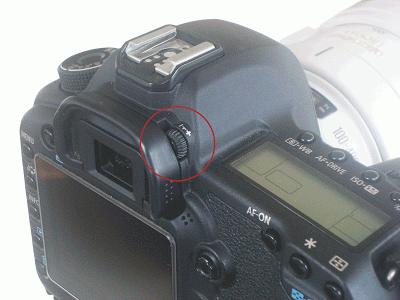
Another question I have been asked a number of times is “what in the world is this small wheel by my viewfinder?” That “wheel” is called the diopter and it serves a very handy purpose for those that need it.


That little wheel circled in red in your vision diopter
 Not everyone has 20/20 vision, many people wear glasses or contacts to make up for our eye’s natural failings and this is where the diopter comes in. When using a camera, it is often not comfortable to wear your glasses as they tend to get in the way. I personally have glasses but only need them for reading and only then because my right eye is slightly weak.

The diopter allows people that normally wear glasses to use their viewfinder without them and still see clearing, although it’s use is primarily only for shooting using manual focus. The diopter has no marking index or starting point, you simply look through your viewfinder without your glasses and if the viewfinder seems to be blurry then adjust the diopter slowly one way or the other until the readout becomes clear.
On the left is before adjustment, on the right, after adjusting the diopter
The diopter only has adjustment from -3 to +3, so it might not be able to compensate for everyone’s vision, some people who are extremely near or far sighted might need to purchase a custom diopter lens to be added to their camera to make their viewfinder clear and sharp for their eyes. It is also possible for the diopter to accidentally get bumped and out of whack for your vision, just tune it back to your eyes and everything is back to normal for you. If you are in a situation where you share your camera with a friend or family member, the diopter will need to be adjusted each time one of you uses the camera.

Now that you have a better understanding of that tiny wheel next to your viewfinder, adjust yours to your eyesight and then get out there and make some great images!


Comments/Questions