Sunday, May 15, 2016

Street Photography

This week I want to talk about a subject that probably makes many of you nervous, Street Photography. Many new photographers cringe at the thought of shooting street, but if you are a photography student, then I am sure you have had a professor or three tell you that you need to learn to start shooting outside your comfort zone.


College student taking a catnap on the steps in Centennial Olympic Park downtown ATL
 Street Photography doesn’t have to be scary and there are some tips I am going to share with you this week to hopefully make you more successful at it. The key to doing Street Photography is being discreet. You don’t want to be out there with your biggest telephoto lens, trying to avoid human contact because you will make your subjects nervous. Take your camera body and a prime lens like a 35mm or 50mm, these lenses will require you to get more up close and personal, but that is the whole idea. Don’t take a flash with you or anything else that will be intrusive or invasive to your subjects, for Street Photography you want to be a minimalist.

Woman walking and texting on her way to bus stop
 Mirrorless is a good camera to use for Street Photography as most of these models are extremely small and light weight, yet make amazing images. Get up close to your subjects and interact with them, talk to them, get a little bit of their story, build some rapport and you will find that Street Photography is not so hard to pull off.

If you are someone like myself who is fairly sociable to begin with and can build an instant rapport with people, then Street Photography will be easier for you. If you don’t have this natural knack, then take it slowly and don’t try to force the issue with your subject. Be respectful of them and their personal space, you don’t want to drastically interfere with their routine or whatever they are doing, but you do need to interact with them enough to make this process easier. Talk to them about the weather, the local sports team, how terrible the traffic is (especially if you live in Atlanta), or anything else that strikes your fancy. Stay away from HOT topics like politics or religion, I don’t want you getting into a hostile debate or getting attacked by some nut.

As you get more and more experienced at shooting Street Photography and become more comfortable, you may find that you really enjoy shooting it. I know I did during the last two years I worked in downtown Atlanta. Also when you become more confident, some people will actually approach you and ask to be shot as part of whatever you are shooting for, I have had this happen numerous times and it can be a lot of fun!

Rodney here is one of the many people that have stopped me and asked to pose for a street portrait
 The important things I want you take away from this week’s blog post is that Street Photography doesn’t need to be scary. If you keep your gear to the bare minimum and take the time to talk to your subjects you will find that this style of photography is not nearly as frightening as you originally thought.

Comments/Questions

Sunday, May 8, 2016

Understanding Aperture

There are three key components of the “exposure triangle”, Aperture, ISO and Shutter Speed, and today we will be talking about Aperture.

An easy way to think of the Aperture of your lens is to think in terms of the human eye. Since your camera’s sensor “sees” things much as your eye does and then records those images in a physical form, we can think of Aperture the same way.

Every lens is made of a a group of glass elements and also a group of Aperture blades. The blades are what limits the amount of light passing into the lens and onto your sensor. These mechanical blades work the same way your pupil works, when in a low light situation, your pupils open up larger to allow more light in so that you can see better and when you are out in bright sunlight, they shrink down to tiny dots to reduce the amount of light coming in.

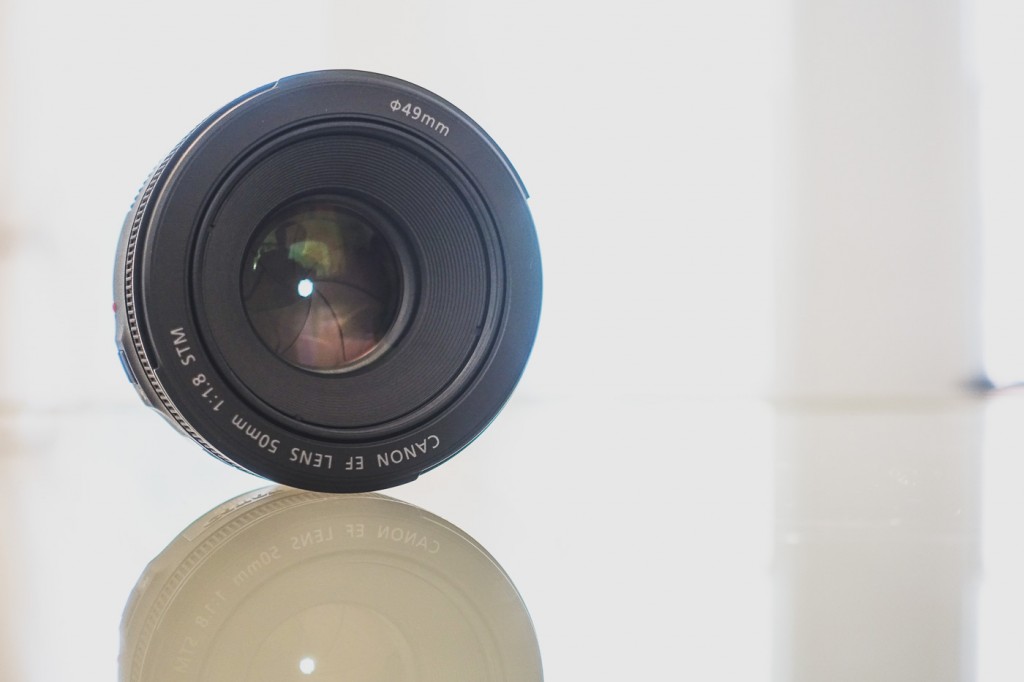
My Canon EF 50mm F/1.4 USM wide open at F/1.4

Aperture blades do the exact same thing, only mechanically and you control them. So a wide Aperture lens like my Canon EF 50mm F/1.4 USM when set at 1.4 is wide open, like your pupil is in low light and I can shoot better indoors at say a concert.

When I am shooting outdoors in sunlight, I will generally set my Aperture to say F/5.6 to F/8 and the blade will reduce the size of the hole in the center of my lens allowing less light into my sensor like the image below of the Canon EF 50mm F/1.8 II. The process of engaging the blades in your lens is known as stopping down as you are reducing the amount of light getting through the lens to your sensor.

Stock image of Canon EF 50mm F/1.8 II with the blades closed all the way
 Aperture is measured in stops and you will see it marked on your lens in the following values. Let’s say you have a standard kit lens of 18-55mm. That lens generally has an Aperture of F/3.5-F/5.6, which means at 18mm it can open as wide as F/3.5 but at 55mm it can only open to a width of F/5.6.

If you are looking at the popular 70-200mm lenses, they generally come in two varieties, F/2.8 and F/4. The F/2.8 model will allow more light, in this case one stop more, than it’s F/4 counterpart.

Aperture also directly impacts your Depth of Field in your images, especially in longer focal length lenses. We all strive to achieve that creamy background blur and bokeh, and using a low Aperture with a longer focal length lens is how that is accomplished. This is one of the reasons wedding photographers will generally shoot with the 135mm F/2 or the 70-200mm F/2.8 lenses. How your bokeh looks in your images depends on how many blades your lens has. A five blade lens will not be able to make perfect circles, but then again, some people like their bokeh to be more angular, where I prefer mine to be as close to perfectly rounds balls of light. When shooting landscapes, by stepping down the Aperture, you can keep more of the scene in focus and get that beautiful wide shot where everything looks fantastic!

Notice the creamy Bokeh in this shot I took in Monroe, Ga.
 Another thing to keep in mind is that every lens has a “Sweet Spot”, which means the Aperture at which the lens shoots at it’s sharpest. You will need to test your lenses for yourself to find that “Sweet Spot” area, but on most lenses, it’s the area between F/5.6 and F/9.


Janice Mcgregor shot this one with the Canon EF 28-135mm check out that blurry background!
 Understanding Aperture is crucial to become a successful photographer and once you master this aspect of your lenses you will becomes more skilled and intuitive at fine tuning your photography.


Comments/Questions

Sunday, April 24, 2016

How to Make Your Camera Battery Last Longer

Most cameras these days can take quite a few photos on a single charge, but this week I am going to share some tips for getting more life and more shots out of the camera’s battery.

1.) GPS - This is a unique feature that a lot of new cameras have these days, but unless you need to tag your location during a shoot, keep this item off. In the course of a day, GPS can drain up to 20% on your battery.

2.) WiFi - Again this is another neat feature to have on a newer model camera, but unless you need to actually use it, keep it off. The last thing you need your camera doing during a shoot is constantly hunting for WiFi networks.


 3.) Sleep Mode - This is a nice item that is on most camera’s menus. Setting the sleep mode to the lowest time possible will allow your camera to save battery life in between shots and the camera wakes pretty much instantly when you press a button. Turning your camera on and off all the time doesn’t really extend the battery life any more than Sleep Mode but it takes a bit to boot back up and you could miss a shot.

4.) Review Time - If you are skilled at using your camera, you can set the lowest possible review time. I personally don’t use the Review at all on my cameras, and most Pros don’t either.

5.) Continuous Focus - Don’t use this if you don’t need it. It can make shooting harder if you need to recompose, but if you are shooting objects that are not moving, it just drives the focus motor constantly and drains the battery.

6.) Image Stabilization - This feature is very handy at have in your camera system at times, but if shooting on a tripod, it can actually impose movement where there should be none.


7.) Live View - Live view is one of the biggest battery drains on a camera system. The viewfinder is there for a reason, photographers got by for centuries without Live View.

8.) Silent Mode - If you don’t need it for the shooting you are doing, turn it off. My EOS 6D has two silent shooting modes and I love to use them when photographing wildlife as even the newest cameras have some clacking when taking photos. If I am shooting a car show or portraits, I turn it off to save battery life.

9.) Built-in Flash - I am not even sure why any cameras come with this these days because they are a huge battery hog, their performance is crap, so why bother put them on cameras to begin with?

10.) In Camera Post Processing - Again, not sure why cameras even have this as you can do a way better job with Lightroom or Photoshop.

11.) Focus Beep - It does not consume a huge amount of battery life but adds up over time and the beeps are annoying anyways.

12.) Light Optimizer and Noise Reduction - Again, not sure why either of these are in cameras to begin with and you can do a better job in your post production software.

13.) RAW + JPG - I know some people like having this ability but you are writing double images every time you press the shutter so you know this is sucking up memory.

Once you’ve turned these all off, you should see anywhere from a 20% even upwards of 40% increase in battery life and total shots you can take per charge.

Comments/Questions

Sunday, April 10, 2016

Back Button Focus

This week I want to talk about a better way to use your AutoFocus on your camera. By default you already know that pressing your shutter button halfway down is how you get your AF lock. The problem is, if you release your shutter, your camera then needs to reacquire focus when you press the button down again. There is an easier way to get your focus and keep it and that method is called Back Button Focus.


The button in this shot circled in white is the one I like to use for BBF on my EOS 6D

Back Button Focus is when you program your camera in the menu to use a button on the back of the body to achieve focus instead of the shutter button. The advantage of this is you don’t lose your previous focus lock when you release the shutter button and then have to reacquire it again to take your next shot. Canon was the first camera builder to add BBF to their bodies back in 1989 and every camera has had it since that time.

To set up BBF on your Canon camera, go into the menu and look for “Metering Start/Meter+AF Start, which I know sounds confusing but that is the option you want. Most photographers that use BBF like myself will us the AF Lock button on the back of the camera. I switched to BBF about a year ago and I personally would not go back to using the shutter button and most pros will tell you the same.

On a Nikon it’s a bit more straight forward in the menu but varies from model to model, but you want to use the AE-L, AF-L button on the back for your BBF, yeah that button that you never use. Now that you know how to set up and use Back Button Focus, give it a try I think once you get used to it you will like it better than using the shutter button.


Comments/Questions

Sunday, March 20, 2016

Do NOT Shoot for Free "Exposure"

One of the things that photographers get asked a lot is “Can I use your photographs for free and give you “exposure”?

This is always a bad idea and I understand that as a new photographer starting out, you might think, “Why not, I want to becomes known”?

The reason you should NOT let people or especially companies use your work for free “exposure” is it hurts the market for every photographer that is out there trying to make a living in this chosen profession.


One of my photos I had a company ask if they could use for free

A lot of times, the client wanting to use your photos will used the excuse that they cannot afford to pay you for your work, which is usually a lie, they just want something for nothing. I remember recently reading an article by David Carson, who is a professional photographer for the St. Louis Post-Dispatch where CBS News actually asked him if they could use some of his incredible photos for free.

David, as you can imagine, was insulted. CBS News is a multi-billion dollar company and they didn’t want to pay him for his work, they expected him to let them use his photographs for free for “exposure”.

It’s so funny how people and companies think photographers should work for free, but they would not do the same thing if you asked them to work for free or “spec”. A few months back I watched a great video put out by an ad agency named Zulu Alpha Kilo titled “Say No to Spec”. This morning I saw the same video re-shared by LightStalking so I thought it would make a good subject for this week’s blog post. You can view their video here.

So, remember, next time someone asks you to work for free “exposure” or spec, just tell them No and send them the link to this video.

Comments/Questions

Wednesday, March 9, 2016

Success for Creative Impostors

This week I was thinking about how hard it is to get my business up and running., The amount of work that we have to do to get noticed as well as thinking about whether I am really good enough to make a living as a photographer.

I think we all go through these stages. Why am I really doing this degree? Are my photographs worth the money that I charge?  Will I be able to do this on a full-time basis and support my family?

Well as I was thinking about this, a blog came across my desk that I often scam through but then seldom read because I just do not have enough time to read everything because of "life" happening around me. Today however I decided to read it for some inspiration and I thought this would benefit a lot of people because of the content.

We are all creative people and when you think you might be an impostor or even someone not worthy of success then I suggest you read this article.

It is taken in its entirety from an article that Amy Butcher wrote over on Big Brand Systems

Don't listen to me but rather read what others in the industry have done and what people thought about them before their success.

Enjoy the article.
Denzil


Imagine you’ve just learned to drive, and you’re about to merge onto the freeway for the first time.
But while everyone is whooshing by in sleek machines with turbo engines, you’re putting along in a beat-up Plymouth with a rattly exhaust pipe. You fear you’ll never get on that freeway, or look as good or go as fast as everyone else.
Kind of like how you feel when you think your creative skills don’t measure up to the best in your business.
But to paraphrase something the wise Pamela Wilson told me, “Why would you compare yourself to the best?” That’s the worst thing to do, whether you are just starting out or have been around for years.
Did you know that in business, you can go really far in a rattly old Plymouth?
To convince you, here are ten “creative impostors,” or people who have succeeded in business even though their production values suck or they don’t fit the typical mold of creative success.
Yet succeed they do.

1. Race Grooves

Race Grooves is a toy car entertainment channel run by Mark Kasimoff, who designs downhill toy race car tracks for kids’ birthday parties.
Hop on over to his YouTube channel, and you’ll find over a thousand videos of him playing with Hot Wheels race sets.
His most popular videos have almost 20 million views, and he was featured on the show Mythbusters. And he’s done this with a website looks like it’s from the dark ages and a personality that is, well, the opposite of magnetic.
What’s his secret?
He committed to creating one video a day for kids who simply want to watch cars go fast and do tricks.
That’s it.
Impostor Lesson: Know the core of what appeals to your audience. Then do that.

2. Napoleon Dynamite

Hollywood has plenty of examples of small movies that go big, but a recent classic is Napoleon Dynamite, a sleeper hit that achieved cult status back in 2004.
It doesn’t get more low-budget bad than this riff on boy-versus-world, with its awkward pauses and stiff dialogue.
Roger Ebert gave it one and a half stars for its “stupidity.”
Audiences swooned for its charm anyway, as underneath the stupidity lay a well of emotion that had people telling their friends and family in droves.
Impostor Lesson: Big heart always trumps big budgets.

3. David Byrne

Talking Heads’ front man David Byrne is one of the worst singers in pop history, with a nasally voice that can barely hold a note.
His fans are extremely devoted, not because he’s the best singer in the world but because of his pre-hipster aesthetic and ethos of anti-consumption. In fact, Byrne’s voice represents an entire generation’s alternative angst.
Listen just once to his cover of Whitney Houston’s “I Wanna Dance With Somebody” and you can’t imagine it being sung any other way.
Impostor Lesson: Distinctive style that speaks to an audience beats generic talent any day.

4. Henneke Duistermaat

Copywriter and writing coach Henneke, who has guest posted for Copyblogger and Big Brand System, got “sick of clichéd stock photography” and decided to start drawing her own blog graphics.
But art isn’t easy. What is easy? Getting depressed at your creative shortcomings.
Six months after starting to draw, Henneke published her first art piece:
“The evening before publication, I tried to perfect the drawing. Henrietta’s nose wasn’t pointing in the right direction, her finger was odd, or the laptop perspective was wrong. I drew 7 or 8 versions before giving up.” – Henneke
She didn’t give up on drawing, but rather on the idea of perfection.
Because in a world that relies on the ready-made, Henneke’s artwork makes her blog warm and personable for her audience, no matter how imperfect her art supposedly is.
Impostor Lesson: A personal connection beats slick yet run-of-the-mill creative output.

5. Zach Galifianakis

Zach Galifianakis should not be famous for his creativity.
His personality is off-putting, and his beard looks like a Yeti threw up on his face.
However, Zach’s humor stands out from the Jimmy Fallons and Jerry Seinfelds of the world who yearn to be liked. He’s translated his hostile style into success in movies and an Internet show, Between Two Ferns, where he pelts celebrities with his word bombs.
In any normal context, Galifianakis would be booed or ignored.
In his own surroundings, he’s the perfect mensch.
Impostor Lesson: Even grating personalities can make business magic with the right context and execution.

6. Fitness Blender

If you’re not a YouTube exercise freak, then meet Fitness Blender, a fitness channel by a husband-and-wife team who don’t look like the impossibly beautiful models who usually do workout videos.
Instead, they’re just regular nice-looking people who promote fitness and healthy eating.
Creatively, their down-hominess can get too quaint: here, you can listen to them go on for ten minutes about their grocery shopping.
Despite small video personalities and an inability to edit themselves, they still shine with authenticity.
The result? Ad revenue from millions of viewers who also support them through patron donations.
Impostor Lesson: Keep things real and people will get hooked on your business.

7. Fifty Shades of Grey

Brace yourself, ‘cause I’m about to let you in on a little secret:
Fifty Shades of Grey is a bloody awful book.
The tome is full of grammar misdemeanors and insipid lines such as “His voice is warm and husky like dark melted chocolate fudge caramel… or something.”
How on earth did this barely run-of-the-mill novel become a trilogy, a movie and a brand that’s still going strong?
Because the fans don’t care a hoot about the writing.
They obviously care about something else entirely…
Impostor Lesson: You can take your business far when you focus less on perfect execution and more on your audience’s desires.

8. Dogs Playing Poker

Since 1903, art critics have panned this series of paintings by C.M. Coolidge for kowtowing to petit bourgeois tastes.
Most of us would readily agree: dogs playing poker just ain’t art.
But the paintings weren’t meant to be art. They were originally commissioned as ads by a cigar company.
They eventually became fixtures of middle-class basement décor because they spoke to an era.
And their kitsch appeal has had cultural legs that many artists would sell their children for.
Impostor Lesson: Ignore the snobs. What’s horrible to them may be exactly what your audience wants.

9. Wikipedia

While Wikipedia isn’t actually a business, this impostor still has a lot to teach about getting far with bad stuff.
Some Wikipedia articles are so boring, your eyes want to escape their sockets and take your brain on the town to drown its sorrows. The content can be nonsensical, overly complex, badly structured and susceptible to hoaxes.
But Wikipedia’s strength comes from the collective action of its volunteer editors who vigilantly edit, add and flag with the dedication of a Roman army.
While the claim that it is better than the Encyclopedia Britannica is arguable, Wikipedia still wins top spot in, well, every Google search.
Impostor Lesson: A dedicated tribe can overcome any creative flaws in your business.

10. Chris Brogan

Successful author and business advisor Chris Brogan has a blog that’s a creative mishmash of musings about things like healthcare and coffee.
In his presentations, he can ramble from one topic to another.
Yet, he’s built an uber-thriving business built on a big message of not living a life that other people set out for you.
And he does it in a very funny, human way.
Mostly, though, Brogan bares his soul like few others online. And that is extremely powerful.
Impostor Lesson: People will love you for your completely honest self, not your perfectly honed thoughts.

Own That Plymouth

In business, you can easily get caught up in comparisons.
Like how someone else has a gorgeous website, killer design, or always-flowing creative juices. But the next time the world careens by you at light speed, just remember that any “impostor” weakness can be turned into a strength.
Don’t know how to draw? Doodle from the heart.
Have a horrible sense of humor? Dazzle your audience with your honestly bad puns.
Can’t afford fancy video or podcasting gear? Win your customers over with simplicity and clarity.
Be as clinky and clanky as you have to be. Because your customers aren’t comparing you to the best in the business. They’re just looking for a simple ride to their specific destination.
And if you can take them where they need to go, then you are no impostor.
You’re a force of business who lets people view some awesome sights, hang out with an interesting person, or learn something new along the way.
And those are all great reasons to get out there and proudly putter down that highway.

Sunday, March 6, 2016

Hosting Your Own Photography Site

This week I want to shift gears a bit as some students have asked about hosting their own photography sites. I know there are many sites out there like Squarespace, SmugMug, ZenFolio, etc that cater to photographers, but most of them are expensive and some even take a percentage of your sales, even though you pay them monthly or yearly for hosting your photography site.

Some students and new photographers have asked about hosting their own photography site and how they could do it. Well I have done exactly that and I am writing this post to share with you the reader. I was using SmugMug, which is an awesome site, but again, expensive at around $30 a month, plus they take a percentage of your print sales or digital sales. In the year I was using them, I only sold around $100 or so, so it was NOT cost effective to use them. I decided to switch to hosting my own site, since I already had hosting with GoDaddy for my personal blog site.

Fluxus

GoDaddy charges me around $200 a year for hosting but I have my own server, I can use as much bandwidth and storage as I want and I can host as many domains as I want. I then went and researched self-hosted site templates and determined that they best way forward was WordPress as their are some companies that make awesome photography templates for WordPress that will even let you sell your images and get paid via PayPal, Square and a few other payment systems. The nice part about doing things this way it you don’t lose any of your money. If I sell a print via my site, the lab that makes the print takes their payment, and I get ALL of the rest of the money!

There are two really good photography themes or templates for WordPress, one is called Photocrati and the other one is called Fluxus. Both of themes are awesome, Photocrati offers e-commerce integration, where Fluxus does not at this time, but Fluxus is a bit easier to work with and you can even use both, since in my opinion Fluxus has a better portfolio options and then use a sub-domain running Photocrati to sell your prints and downloads.


Photocrati

The tricky part about hosting your site yourself, is you need to know WordPress, which takes time to learn well, or you can hire someone who is a WordPress expert to do it for you and once set up, maintain the content yourself. WordPress also has tons of both free and paid plugins for SEO, Caching to make your site faster, etc.

I don’t want to make this article too long so I will close here but now you have something else you can consider, especially when starting out and money is tight.  If you want to check out my site, just pop on over to Liam Photography

Comments/Questions